A practical water safety roadmap for growing businesses
Your water safety plan should match your business today and be able to grow alongside it.
Employers and anyone in control of premises need to assess and manage the risk from Legionella. For one office, that might mean a risk assessment and a named person handling checks. A larger estate that’s grown to dozens of sites might need centralised reporting and remote monitoring too. Aquatrust works with businesses at every point on that journey and can grow with you.
There’s no fixed programme that suits everyone. Your risk assessment sets the direction and it’s revisited whenever the system, building or its use changes.
Start with the foundations
Your water safety duty comes from the Health and Safety Executive’s guidance on Legionella and Legionnaires’ disease, and it starts with looking properly at the water system. How is water stored and distributed? Are there outlets that rarely get used? Are temperatures being controlled? Who uses the building and are any of them more vulnerable?
Someone in the business needs to be the Responsible Person: the person who’s accountable for managing the risk, even if a competent person carries out the assessment itself. That person makes sure the actions from the assessment are carried out. Depending on the site, that could include a written scheme of control, routine monitoring, maintenance work and staff training.
Some sites need a fairly simple programme while others need much closer management. The most important thing is that the actions come from a unique risk assessment. Copying a water safety plan from another building rarely works because the systems and risks won’t be the same.
A four-stage roadmap for developing water safety controls
A useful way to look at developing your water safety is in four stages.
You might move through them as the business grows, but size isn’t the only factor. A small care setting might need tighter water safety controls than a much larger office. The water system and the people using it, especially if they’re vulnerable, decide what support is needed.
Stage 1 – put proportionate controls in place
Take a small office with a basic hot and cold water system. The first job is to make sure the risk has been assessed and the Responsible Person is named. Any work flagged as needed during the assessment should be scheduled in and the results need recording.
At this stage, setup is generally simple.
- The Responsible Person is named
- A schedule is put in place
- Records stay in one place
- Faults and odd results get followed up
- The assessment gets reviewed when something changes
We often speak to smaller businesses that expect water safety compliance to involve a huge programme. Usually, it just begins with understanding the site and putting sensible controls around it.
There’s no point adding layers of work the building doesn’t need, but the basics do need to be covered properly.
Stage 2 – strengthen control as your estate changes
Water systems change over time. You might extend the building or change the pipework. You might also take on another unit. Parts of the premises might sit empty for longer, or the building might start being used by a different group of people.
Those changes can affect the risk, so the assessment needs another look.
Typical triggers include:
- New premises or an extension
- Changes to tanks, heaters, outlets or pipework
- Refurbishment work
- Low-use or empty areas
- A change in occupancy
- More vulnerable users
- Problems found during monitoring or maintenance
Responsibility can also sometimes become less clear as the business grows. One facilities manager could have handled everything at the start. Later, several new people or contractors might be involved. At that point, everyone needs to be clear on what they’re responsible for and who picks up an issue when a check fails.
Stage 3 – create consistency across sites
Managing one building is very different from managing 20, 100 or 500. Once you’re responsible for several sites, visibility often becomes the problem. You need to know what’s been completed and when, and what’s overdue. You also need to know that every building is working to the same standard.
Separate spreadsheets and different reporting methods can make water safety management harder than it needs to be.
A good shared approach includes:
- The same reporting format at every site
- Clear responsibilities for local and central teams
- Planned service visits
- One process for escalating problems
- Central access to reports
- Regular reviews with your water safety provider
At Aquatrust, we support North Yorkshire Council across more than 500 sites, including schools, care homes, offices and leisure centres. Setting the contract up meant bringing systems and records together across a large area, while keeping necessary work on schedule at each individual building. For such a large organisation, a clear central view matters because it lets the council see where things stand without chasing updates site by site.
Stage 4 – use remote monitoring where it adds value
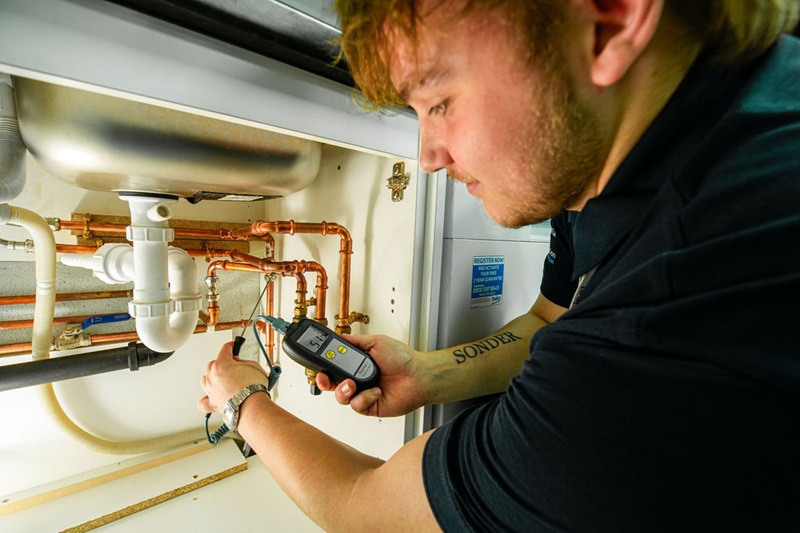
Remote water monitoring uses sensors fitted to the pipework to record water temperatures automatically and send the readings to a secure online dashboard.
Aquatrust’s sensors take a reading every 30 seconds. The data is sent to the dashboard every 15 minutes, giving 24/7 visibility of every site and alerting us if a reading falls out of the expected range. The sensor batteries last up to 10 years, so there’s little routine maintenance involved.
That helps us get a much fuller picture of what’s happening inside the system.
Remote monitoring is useful for:
- Larger estates
- Buildings that are difficult to access
- Sites with repeated temperature problems
- Teams dealing with a high volume of records
- Organisations looking to reduce routine travel and water use
It can also make sense in a single building. It depends on the system and what you need to keep an eye on. The model can be used on anything from one building to hundreds of locations, but it’s still one part of your wider water safety plan. Your risk assessment, maintenance and any necessary physical checks still apply.
How remote monitoring can support compliance and sustainability
Remote monitoring creates automatic, time-stamped temperature records, which removes a lot of manual paperwork and gives you a clear audit trail.
Because the readings continue throughout the day, our team can pick up patterns that a one-off check might miss. A temperature might look fine when an engineer visits but move outside the expected range later. Seeing these patterns means we can look into the cause sooner.
There’s a water-saving angle too. Manual checks usually mean running outlets while readings are taken, and that adds up across a large estate. Remote sensors collect regular temperature data straight from the pipework, which can reduce the amount of water used during monitoring.
One Aquatrust customer saved over 160,000 litres of water a year after switching to remote monitoring. Every estate is different, but it shows what’s achievable when the need for manual temperature checks is reduced across a number of sites.
What a long-term water safety partner should provide
You should always know what needs doing and why. Our advice is based on your building, not a standard package rolled out to every client. Reports are easy to follow, with actions ordered clearly so you know what needs attention first.
Finding a problem is only one part of the job. We explain the next step and arrange any remedial work, then we check it’s actually been dealt with.
We’ve worked in water safety and Legionella control for over 20 years. We’re ISO 9001 certified and are members of the Legionella Control Association. Our skilled engineers and risk assessors work directly with clients – we don’t outsource – so you’re not passed between different providers.
That consistency matters if your needs change. The same familiar team already knows your buildings, your systems and what work’s been done before, and can plan service visits around what your sites actually need rather than a generic schedule.
When should you review your water safety arrangements?
Your Legionella risk assessment should be reviewed if it no longer reflects the building or how it’s used.
That could be because:
- The water system has changed
- You’ve taken on another site
- The building has been refurbished
- Occupancy or use has changed
- Different people are now using the building
- Part of the building has been left unused
- Monitoring results suggest something isn’t working
- Responsibility for the system has changed
Frequently asked questions
How do I know what level of water safety support my business needs?
A Legionella risk assessment is the starting point. It looks at your water system and how the building’s used. From there, you can see what checks and controls are needed and whether your team can manage them internally or needs outside support.
When should a Legionella risk assessment be reviewed?
Review it when something changes that could affect the risk. That includes changes to the water system, building work, different occupancy or new premises. Results from monitoring or maintenance can also show when your current controls need another look.
Can remote monitoring support Legionella compliance?
Yes. It records water temperatures automatically, keeps time-stamped records and can help identify changes in your water system’s performance.
Is remote water monitoring suitable for a single building?
It can be. A single building might benefit if the system is complex, access is difficult or manual monitoring takes up a lot of staff time. We’d look at the site and explain whether remote monitoring would be useful for you.
How can water monitoring reduce water waste?
Manual temperature checks often require an outlet to run while the reading is taken. Remote sensors collect temperature data directly from the pipework, which can reduce the amount of manual flushing needed.
Put the right plan in place now, then build from there
You don’t need to have everything worked out before you speak to us – we’ll help you work out exactly what your site needs. You also don’t need a large estate or a complicated water system. We support smaller local businesses as well as larger organisations.
The starting point is the same. Just tell us what buildings you manage and what you already have in place. We’ll take a look at your current setup, explain clearly what needs attention and help you put the right level of support around it. If the business grows later, we can build on what’s already there.
Need help with your water safety? Get in touch with our team and we’ll talk you through the next steps.